Archive for the ‘Technology’ Category

Web 2.0 – All that glisters is not gold

December 20, 2007

Just in case you’re interested my editorial for the Journal of Librarianship and Information Science has just appeared in their December issue. It is called “All That Glisters Is Not Gold – Web 2.0 and the Librarian” and is also available as a pdf from the  Chartered Institute of Library and Information Professionals (CILIP).  A lot of it is based on my recent Web 2.0 report but I have aimed this more squarely at librarians and information science professionals.

Ray Mears: slow technology and wild lunches

December 11, 2007

If there’s one man who knows how to get his hands, quite literally, on a lunch it is Ray Mears. Arctic chard, monitor lizards, bison, witchetty grubs: the TV survivalist expert has tracked, trapped, skinned, picked and eaten a glutton’s list of wild foods using the tools and methods of indigenous tribespeople across the world.

In a throwback to the old-fashioned public lectures given by explorers, Ray visited Derby recently. And in the hope of getting a few tips for my own lunchtime forays, I headed over there to hear what he had to say. There were many interesting and amusing anecdotes about his times in the wilderness but one thread stood out for me.

Wild hunting and food gathering is incredibly slow and deliberate. It utilises an enormous amount of inherited local knowledge and the use of appropriate tools—what we would call technologies. As an example of this, Ray described how it takes 14 hours to prepare ice holes and a net in order to catch an Arctic chard (a type of fish).

Sadly, Ray made it clear that in his twenty-year career he could already see many examples of how these skills were being lost, largely because of how the modern world is rapidly encroaching on the last of the truly wild areas.

In essence we are ‘forgetting’ how to get our lunch. Puts a different complexion on popping out to the shop for a sandwich, doesn’t it?

It’s a BERR’s life: Second Life in the public sector

December 6, 2007

You know when an innovation is really taking off when parts of the public sector start to make use of it. This now seems to be happening with the virtual world Second Life.

At the European Union’s Privacy Conference (which I mentioned last week) I was involved – for the first time – in a roundtable discussion which was also featured ‘live’ within Second Life. The physical discussion took place in the Department for Business, Enterprise and Regulatory Reform’s (BERR) new Futurefocus centre, deep in the bowels of the department’s Victoria Street offices. At the same time, a group of 20 or so avatars gathered in a virtual version of Futurefocus. Indeed, one of the presenters (Paul Ledack of IBM) was not physically present, but was, in fact, one of the avatars. Everything we said within the physical room was also being streamed out to the gathered avatars who could post questions by in-world text. We could see the avatars via several large screens within the room and a moderator handled the interface between the real and virtual discussions.

This kind of mixed reality meeting seems to slowly becoming more commonplace. On the same day a NHS event was taking place elsewhere in London with several hundred clinicians and this was also online in SL (through the weblink secondhealth.org.uk). And I gather that the Climate Change gathering in Bali will also have a parallel, Second Life, event hosted at Nature magazine’s SecondNature virtual island.

All this public, indeed governmental, use of SL raises questions. Second Life is a private space owned by Linden Labs and the privacy experts in London had a number of concerns over the clarity of exactly who owns what and how data privacy was being handled within the various islands within Second Life.

Tech Bubble 2.0 – the anthem

December 5, 2007

Here is a laugh out loud, satirical YouTube video by Richter Scales on the dawning Web 2.0 technology stock bubble that has come via Kara Swisher of the Wall Street Journal.

I suggest that you are not eating lunch or sipping hot coffee from a mug when you hit play. It could get messy!

How many scientists does it take to change a light bulb?

November 29, 2007

A twist on the old joke may now have a more formal answer. I was recently pointed to a paper The Increasing Dominance of Teams in Production of Knowledge, published in Science magazine, which looks at the size of teams involved in the production of new research. The authors, Stefan Wuchty, Benjamin Jones and Brian Uzzi reviewed the authorship of 19 million papers produced over five decades to see if there were any patterns.

What they claim to have found is a move from the lone artisan to larger teams of researchers. This was the case not only in science and engineering, where there are obvious, practical drivers to move towards teamwork (shared use of expensive equipment for example), but also, to a lesser extent, in social sciences, humanities and arts. The lone genius battling against the prevailing consensus is a powerful image in the history of science: think Darwin or Einstein. What these researchers are arguing is that they don’t believe this is the case any longer.

But is this accurate? I have to confess I’m a bit worried about this piece of research, partly because the authors only look at (predominantly US) research papers and patents and don’t take account taken of, say, the impact of funding regimes or the ‘politics’ of producing papers. I suppose what it boils down to is that, for me, if you wanted to investigate the question that the research purports to shed light onto, you’d have to do a lot more than add up the number of contributors to academic papers and show that this number has increased over the years. Still, the Wisdom of Crowds tribe will love it and I dare say we’ll hear a lot more about the paper from that quarter.

And the answer to the joke? According to the statistics given in the paper it’s 3.5.

Tax CD-ROM fiasco

November 23, 2007

An abridged version of this appeared in the Guardian newspaper’s letters page today

As chance would have it a major EU-sponsored conference on privacy, identity and technology was taking place in central London yesterday, as news broke of the UK’s tax CD-ROM fiasco. I was one of a hundred or so experts from across Europe from a wide variety of technology, research, and legal backgrounds who were debating these issues.

Whilst the discussion at the conference raised many pertinent points about technology and data protection, mainstream news reporting has centred on whether cost cutting within HMRC is to blame. Personally, I find this rather disappointing. No doubt this is great fun for political point scoring, but basic data protection measures cost little if any money, in terms of staff time (which is where the debate has focused), to implement.

For example, why was even the most simple data encryption not undertaken? Why in the age of the Internet and highly secure Government data networks are CD-ROMs flying about between different parts of the public sector. Sending a disc by TNT post surely costs more than using a data network.

It should also be borne in mind that none of this is new. As Jonathan Bamford, from the Office of the Information Commissioner, pointed out in his speech to the conference, the data protection framework that is supposed protect citizens’ private data in ICT systems has been in place for twenty years. I think that in the Tax CD-ROM case there seems to be some evidence that this was ignored, possibly with the knowledge of senior managers.

All of this means that there is a pressing need to address the lack of public confidence in the Government’s ability to protect our personal data. Jonathan Bamford made reference to the latest survey undertaken by the Office of Information. This shows that protection of personal information was ranked, by the general public, as their second highest concern—just below fear of crime. This survey was taken before yesterday’s events and placed privacy concerns above worries about the health and education systems.

Data protection of citizen’s information should be hardwired into the DNA of government departments and agencies. It clearly is not, judging from this case. Until it is there should be no more talk of a national ID system.

Google goes crowdsourcing for an iPhone ‘killer’

November 16, 2007

I recently mentioned the rumours surrounding the possible release of a Google gPhone which would be in competition to the Apple iPhone. It appears that this is not going to happen now, at least not in the sense of a distinct, hold-in-your hand, physical product.

(more…)

My online identity mash-up

November 14, 2007

There seems to be a steady trickle of whizzy little apps that manage one’s public persona in Web 2.0 applications. I recently noted the MoodBlast tool, but the latest, Second Friends, allows you to import your Second Life avatar details into your Facebook profile and comes courtesy of EduServe’s Andy Powell (via his Second Life alter ego Art Fossett).

By creating an open Applications Programming Interface (API), Facebook is encouraging this kind of innovation on top of its core product. Andy Powell’s widget could be the first stage of a larger development where you can control your avatar in Second Life, from within Facebook.

This got me thinking. Increasingly a real person is represented online by a variety of virtual personae, aspects of which are filtered through different applications.

Somebody, somewhere, probably in a back bedroom, is building some kind of amalgamating, persona application that allows easy control of all these aspects from one handy desktop widget. This would be a true identity mash-up.

A summer romance? Geeks and unlocking the iPhone

October 31, 2007

Apparently, Britain is about to be hit by a two-week media barnstorm in anticipation of the long awaited launch of Apple’s iPhone on 9th November. Given the long dark evenings and the autumnal wet weather we probably won’t be witnessing the camping-out-in-sleeping-bags and sharing-of-thermoses outside retail stores that happened in America this summer when the product was launched. But there may be other reasons why the UK won’t be quite as head-over-heels in love with the iPhone.
(more…)

Philips’ window on the future

October 26, 2007

I have seen the future and it will be well lit. That’s according to European electronics giant Philips, whose Applied Technologies division invited me to an open day for journalists on Tuesday.

The day featured a tour of mocked-up, every-day scenarios under a general theme of ‘care’, which were designed to demonstrate various technologies and how they integrate with each other. This included a hospital room of the future, a hotel room and a pre-natal clinic, and was followed by a tour of their ‘high street of the future’, in which technologies were shown in various retail and domestic settings. The clever use of light and light-related technologies featured in almost all of these.

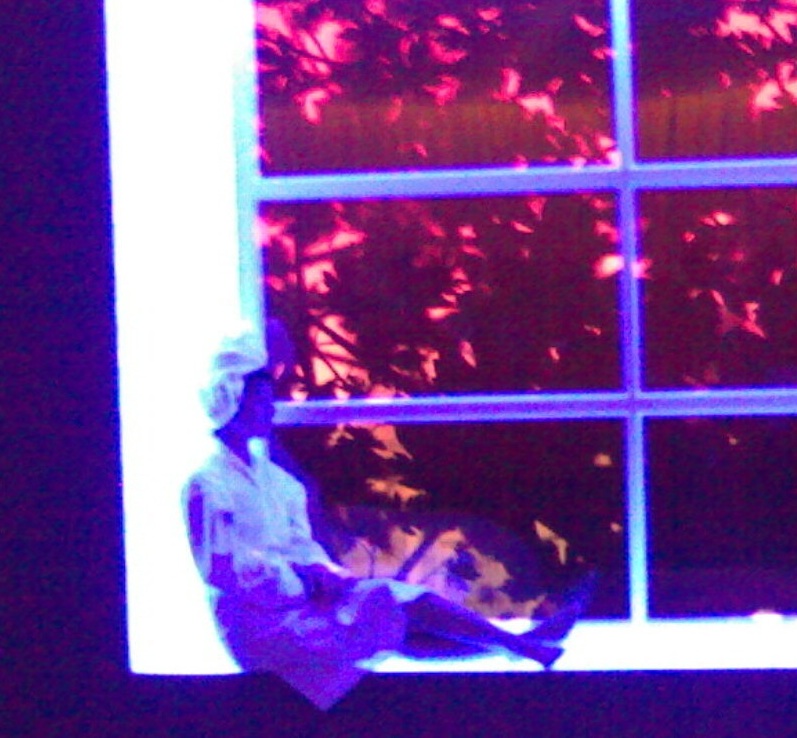
The hotel room scenario struck me as being the most impressive in terms of both flashy technology and end-user usefulness. In the scenario, a businesswoman is shown arriving at a hotel for the night. Her room has been fitted with a Daylight Window with Personal Mood display, which the guest controls by standing at the window and moving her arms: there is no computer keyboard or mouse. Philips Daylight WindowBy interacting with the ‘window’ the guest can create an image across its length and breadth and alter that image to let in different amounts and colours of light. In the example I saw it was the branches of a tree, which ‘grew’ across the window and could be made more or less dense, just by the sweeping action of an arm (see the first photo).

If this seems a bit superfluous to you, there is a more practical use of the light technology. Our aforementioned businesswoman, tired, and suffering from stress and jet-lag, is able to sit in a corner Woman using blue light therapyof the window and indulge in a kind of ‘light bath’ (see second photo). Based on research from Chicago’s Northwestern University, which has suggested that such ‘blue light therapy’ can shorten jetlag recovery times, the Philips concept incorporates this idea of the therapeutic effects of light into its vision of the future.

In this scenario, light is being used as a way to make people feel better and enhance their mood. This is quite interesting in as much as it represents a slight fork in the standard route for ambient computing, where the emphasis is often on getting computers to complete or assist with a task such as opening a door. In this scenario, the functionality is new and aspirational.

This strategy may reflect some of the changes that Philips has undergone in recent years. Through reorganisation and shedding of parts of the business, like its silicon chip development wing, the company has refocused on what might be called the ‘softer’ side of technology. It believes that its future growth will come from merging its traditional strengths in areas like medical technologies and lighting into new, ambient solutions that work with users unobtrusively. We are going to see a lot more about the use of light in the next few years.