Exploiting the Social Graph

July 3, 2012

The Web is now a subject of academic study outside the confines of computer science. It is informing, and being informed by, a range of different disciplines as diverse as law, economics and media studies. However, because of the huge data sets about individuals and their social ties that are being collected, the potential for social science and computing is especially strong.

As Cameron Marlow, in-house sociologist at Facebook, recently told MIT Review:

“The biggest challenges Facebook has to solve are the same challenges that social science has…”

Up until fairly recently, social science was essentially restricted by the difficulty of obtaining data from large numbers of people, such as accurate details of their friendship links. Web 2.0 services can now provide that data easily as millions of us have happily uploaded and shared details of our private lives, creating what are known as social graphs, studied formally by graph theory.

Back in September 2010 when I was writing my book I came across the philosopher Pierre Lévy speaking to the Royal Society to the effect that: “Graph theory will be one of the main bases of the future of the human sciences”. At the time I thought Lévy was taking things too far, but it is now clear that social media, the exploration of complex networks and the scale of data being collected have opened new and fruitful horizons for the humanities. Added to the drive and ambition of the companies involved, he might not be far wrong.

What is a troll?

June 14, 2012

It makes for a cracking headline, but Internet ‘trolling’ is not the abusive behaviour that has been reported in various newspaper articles this week.

Subs from both the Guardian (‘Internet troll told by court to keep away from public figures’, 12 June) and the Telegraph (‘Trolling abuse got worse for victim Nicola Brookes after Facebook victory’, 11 June) have had fun with this word in the last few days.

The truth is though that the word ‘trolling’ has been widely used in Internet circles for years to refer to the act of tying up online forums, and other social media, in meaningless and time wasting discussions. The idea is to post something that is deliberately incorrect and lure other users, particularly newbies, into wasting time arguing about it. According to net scholar Susan Herring and colleagues at Indiana University it derives from a fishing term whereby a baited line is dragged behind a boat (see an example paper here).

The behaviours described in the newspapers are more accurately described as ‘flaming’, or more succinctly, just abuse.

Saddle Up the Pono

June 7, 2012

“I feel like more than just a number.”

Neil Young, Computer Age, (track from the album Trans)

For many years, rock musician Neil Young has been highly critical over the move to digital formats. His beef is simple enough – the digital formats in use today lose too much of the music; MP3 for example only retains about 5% of the data from the original mix. Many people claim this is irrelevant as they can’t hear the difference, but to a musical purist like Young, they are missing something important from what he has created.

Recently he told Walt Mossberg, in an interview for the Dive Into Media conference, that his solution is an ‘iPod for the 21st century’: a new player and a new format that “some rich guy” would produce. He then revealed that he had been talking to Steve Jobs, just before he died, about such a device.

It was later revealed by his publisher, perhaps inadvertently, that the device would be known as a ‘Pono’ and Rolling Stone magazine have found that various trademarks, such as SQS (Studio Quality Sound), have been registered.

In an interesting development, when I pre-ordered the latest Neil Young album (on vinyl of course) I was sent a free, digital download track. It came in the Free Lossless Audio Codec (FLAC) format, which is open source and can handle 24-bit audio: the same resolution at which most bands record their albums these days.

My impression from the interview with Neil Young is that he’s not convinced that FLAC is quite there as the ultimate digital format. But no doubt the quest goes on and once again, Apple are the one to watch.

Chinese Social Media

May 24, 2012

QZone is one of China's biggest online social networks

One of the interesting aspects of research for the book was finding out more about how social media is used outside the West. In particular, there is a huge, and mainly homegrown, Web 2.0 environment in China. Services such as QZone, RenRen and CyWorld dominate their home market and have hundreds of millions of users.

I was reminded of this a couple of days ago whilst reading about the Facebook IPO. The Guardian published an analysis by technology editor, Charles Arthur, which included the following quote from Ed Barton, a digital media specialist:

“Facebook depends on advertising, and I would highlight that the fastest-growing internet media markets are China and the Far East, India and Brazil. Facebook’s potential is nowhere near as strong in those as it has been in the US. And in those markets there are often a number of locally oriented social networks already in place.”

With billions in the bank from its IPO, the normal route to expansion for Facebook might be a major purchase in one of these emerging markets. But things are never that simple in one-party-state China. The IPO may have run into local difficulties in the last few days, but the battle for Chinese users is a longer term strategic challenge for the company.

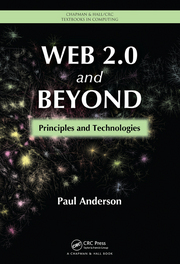
Web 2.0 and Beyond is published

May 18, 2012

A couple of years ago I was approached by an American publisher about the possibility of writing a general reference/textbook that covered Web 2.0 and Social Media. It followed on from the success of a report I wrote for JISC in 2007, which was written for both technical and non-technical readers, and the publishers wanted something similar, but more of it.

Well yesterday a friend rang to ask if I knew that the ‘buy’ link had been activated on Amazon, so I guess I can say that my book, Web 2.0 and Beyond (published by Chapman & Hall/CRC, a computer science imprint of Taylor & Francis), is well and truly published.

The remit was challenging – CRC were developing a new series, aimed at reinventing the textbook format. Their point was that, increasingly, it is students from business studies, economics, law, media studies, psychology etc. who want to understand what CompSci is up to but who don’t necessarily have the deep technical knowledge to really understand how the technology came to be or what the implications of it are. However, as CRC is primarily a computer science imprint they also didn’t want to compromise on the requirements of their primary audience.

I was particularly interested in this idea because studying social media is increasingly becoming an interdisciplinary melting pot. Also, having taught computer science I was keen for students to have a well-rounded sense of the discipline – that they should have a sense of context rather than just learn how to write code. I could also see parallels with Web Science, the study of the Web as the world’s largest and most complex engineered environment (which at the time was only just starting to emerge), and I thought that if ever there was going to be a moment when it was possible to bring all this together in one book, it would be now.

The tricky thing, of course, was getting it all to come together. With the help of some extremely skilful editing I think what we’ve done is to obey three golden rules: only tell readers what they need to know at that point in time; use narrative techniques that engage the reader and allow them to read through the filter of their own discipline; and to keep highly specialised information (hard-core technical information, overviews of research etc.) in separate sections and chapters.

The framework for all of this is the ‘iceberg model’, which tackles Web 2.0 using a layered approach. The premise of the book is that if you understand the iceberg model you will be better equipped to understand how the Web is likely to evolve in the future. There are, of course, a few pointers as to what that might look like.

In the spirit of Web 2.0 there are also various information sources associated with the book. There’s a YouTube channel where I post information about relevant videos, and you can find out about these if you subscribe to the book’s Twitter feed (@web2andbeyond) where I also post other snippets of relevant information that help to keep the book fresh. More detailed information is on the book’s Facebook page (www.facebook.com/web2andbeyond), which also includes notes and excerpts to give a taste of the narrative style of writing I mentioned earlier.

It has been a while in the making and part of me still can’t believe that it’s actually here, but it is, so now all I need is for people to buy it. Hint hint.

Bubble 2.0?

May 2, 2012

My new book on Web 2.0, which comes out later this month, concludes with a brief review of the prospects of us entering a second Internet stocks bubble. Although somewhat forgotten now (eight years is an eon in computing), the original concept of Web 2.0 emerged out of the dot-com crash that followed the Internet bubble of the late 1990s. With the Facebook flotation and recent purchase of Instagram this has become a topical issue, and I was interested to read a piece on GigaOm which reviews the evidence for and against.

A spicy lunch

March 27, 2012

If your idea of a good lunch is a spicy snack, then you’ll enjoy reading my good friend Raz’s blog item on the secrets of a good Bombay Mix. It is an extraordinarily thorough review of what’s on the mix market and shows the attention to detail for which he well known in techie circles. Eat your heart out Which?

Down but not quite out

February 6, 2012

First of all, I should say, I’m a big fan of Nicholas Lezard. I consider his weekly column ‘Down and Out in London’, published in the hinterlands of the New Statesman, to be part of my weekly reward structure. The title of the column gives you the gist of the content, so I was a bit bemused to read recently about Marta, his cleaner. My point, in a recent letter to the magazine, was that only in London could a penniless book reviewer who lives in a hovel have a cleaner.

Well, this week he has responded to my concerns in some detail. Apparently Marta’s services (for which she is paid £12.50 per hour) come with the hovel. And in fact, as she only comes in to ‘do’ for a couple of hours a week, Mr L has had to encourage his feminist flatmate to take up some of the slack, an approach which seems to have proved to be entirely unsuccessful.

Bearing in mind my expertise I thought I might offer Mr L some advice: robots. Indeed for small fee (£12.50 per hour is a king’s ransom in Nottingham) I could even install a basic system, controlled via the Internet of Things (for more on this, see my forthcoming book, available from all good book shops).

Furthermore, in preparation for his life as a digeratus, he should perhaps consider reviewing Sherry Turkle’s latest book, Alone Together, in which the MIT professor outlines her thoughts on robotic technology and our relationship to it. As one of the book’s interviewees says: “Show me a person in my shoes who is looking for a robot, and I’ll show you someone who is looking for a person and can’t find one”.

While this might have a tinge of unrealistic expectation and an unwillingness to compromise, I think it’s much more helpful to think of it as pragmatism. And in my experience, it is always easier to get a robot to do the cleaning than a feminist.

2012: meme or mayan?

January 11, 2012

The turning of the year is always a time for foresight, but 2012 has been imbued with special significance thanks to the Mayan Long Count calendar. Despite our impending doom, on the Web there’s the usual slew of new year prediction stuff: a proper Apple TV – to be or not to be; will cloud computing continue to storm; can Windows 8 save Nokia, or even Microsoft; how long will e-mail last as a form of communication. However, amongst the low-hanging fruit there was a handful of more interesting and thought provoking predictions so here goes (in no particular order):

On the Web 2.0 front, entrepreneur Elad Gil has predicted that 2012 will be the year of what he calls ‘social curation’ – with services such as Pinterest and Storify showing the way. Fast Company predict a significant new player will emerge in online social networks in 2012 whilst Gartner are arguing that by the end of 2014, at least one social network provider will become an insurance sales channel.

In the wider technology arena, Intel predicts that 2012 will be the year that ultra-books – razor-thin laptops which use very little battery power – will come to dominate the PC market, whilst Vivek Wadhwa at the UC Berkeley blog argues that it’s ultra-cheap tablet computers that will become all the rage. Silicon Republic predict that the London Olympics will be the key event to kick-start serious interest in electric wallets using Near Field Communications (NFC) as an enabler of mobile commerce.

Finally, the television looks set to become an important technology battleground in the coming year. As well as the plans for Apple to enter the TV market, Google has announced various developments in this area. However, something that hasn’t received the attention it’s due (and which we were trying to get people to think about back in 2007) has been highlighted by MSNBC: 2012 will be the most significant year in TV display technology since 1997, thanks to the introduction of super-high definition OLEDs, a technology that uses a lot less energy than LCD.

All this assumes, of course, that we make it to the end of the year without galactic alignment, geomagnetic reversal, or alien invasion.

iPoetry

December 16, 2011

From the blog that gave you the edible iPod and social computing for puddings, I now present… iPoetry. Following on from a mid-winter poetry reading by authors from Salt Publishing’s Modern Voices series earlier this week, I thought I’d round off the year with a poem by Manchester-based poet and fellow techie Adrian Slatcher, which he has kindly given me permission to reproduce. As you can see there is a strong hint of something Internet-related and it seems a fitting note on which to end the blogging year. This could be the unofficial anthem of the newly emerging Web Science agenda, which seeks to understand what we have created and where it is taking us, and of which I suspect we’ll be hearing a great deal in 2012.

A Colossal Machine

Rewinding our histories can’t play the tape,
For that requires a colossal machine,
That has long gone out of production,
Or has yet to be made. In part, it’s myth,
Yet we subscribe to it, our site feed
Syndicating the latest news, as if a thing
Can be dripfed to us through words.

The manual alone would be extensible,
Using a language shared by half the world’s tribes,
Competing to contribute to a shared goal.
The ultimate prize for the next life;
Our essence read, stored, accidentally erased,
Whilst the tests go on in private.
In my room I murmur a prayer.

Adrian has also done some interesting things with technology to link readings to user responses, but as this is only available on his iPhone I haven’t got a link to post. However, there is a video of Adrian reading Colossal at his website and if you are in the Manchester area today then he is appearing at the Whitworth Art Gallery this evening.

Wishing you all a Merry Christmas and a peaceful New Year.