Archive for the ‘Fun’ Category

So, farewell then Bill Gates

June 27, 2008

Throughout my entire career in the computer industry Bill Gates has been an omnipresence as Microsoft bent the industry around it like a giant star bends gravity. He retires today. These days that star is arguably beginning to fade as the post-PC era takes shape and so perhaps he is bowing out at the right time.

There is so much that could be said about Gates and his work, and no doubt there will be acres of coverage in the print and online media this weekend. However, in the best and slightly irreverent traditions of this blog (and because it’s Friday), here are three things you perhaps didn’t know about Bill Gates and probably won’t read this weekend:

  • His favourite subject at school was geography
  • He was once sent by his parents to see a psychiatrist because they thought he was an underachiever
  • He enjoys butter pecan ice cream

Star Wars: the road movie

April 29, 2008

Every self-respecting computer geek of my generation can tell you precisely where they were at the moment it happened. Sitting in the dark, blinking at the screen, when suddenly the enormous bulk of a Galactic Empire battle ship thunders across the empty night sky of a galaxy far, far away…

It’s the opening scene of the original Star Wars film of 1977 of course, and I was 13 and sitting in the long-gone Odeon cinema, Birmingham. The scene quite literally took my breath away.

It’s a pleasant memory of a time when a film fired the imagination of my teenage mind, but my interest pales into some kind of interstellar insignificance compared to that of one Ernie Cline of Austin, Texas. A self-confessed complete Star Wars nut, he has written and directed “Fanboys”, a comedy, road-movie-meets-geek film in which a group of hard-core Star Wars fans travel across America in a pizza van, converted to look like the Millennium Falcon, on a mission to break into George Lucas’s famous SkyWalker Range in order to steal early rushes of the next Star Wars film.

Initially begun as a labour-of-love amateur film project it’s been picked up by Kevin Spacey and given the full Hollywood support complete with walk-on parts featuring William Shatner and Carrie Fisher. The full story is told in this month’s Wired and there’s more detail at Movie Insider and a trailer on YouTube.

I predict an inter-galactic smash hit.

World’s first computer animation?

April 10, 2008

I was at a computer conference the other day where this YouTube clip was shown. It shows “The Kitte”, a 1967 animation by the Russian, Niklaevich Konstantinov, and is described as the “first animated sequence using a computer”.

What’s interesting is that it is not quite clear how this animation was generated. It was posted by UnFathomable42 who says that as far as he is aware it was entirely generated by computer. However, if you read the comments that follow the video, there are several people who argue that what actually happened is that the computer printed out a series of pictures of the cat onto paper and these were then animated in traditional fashion by taking a film camera shot of each picture to form each frame.

See what you think. It’s not quite Rhubarb and Custard, but the cat walking along is fairly impressive. But is it genuine? I’d love to know more about this clip’s history if anyone has other historical information.

A geek flowchart

March 11, 2008

Continuing the theme of Gary Gygax and Dungeons and Dragons, I see there is also an obituary in the New York Times, which includes a spoof flowchart of the life of the typical geek, beginning with early exposure to D+D.

It seems from the flowchart (bottom left hand corner of the full diagram) that, since I am now blogging about the diagram, I am one short step away from being in a basement, by myself, in the dark.

If only this were true. A bit of peace and quiet wouldn’t go amiss.

So farewell then to the twelve-sided dice

March 10, 2008

I was sadden to hear the news that Gary Gygax, co-inventor of the Dungeons and Dragons role-playing game, has died. I confess that, like many computer scientists of my generation, I was an active player in my youth and I had one of the first copies of the UK version of the game. Although 1970s Britain may have been a grey and grim place of mass unemployment and stagflation, the game easily transported me to a magical land of dragons, trolls, swords, sorcery and heroes.

These games involved nothing more sophisticated than a group of people, lots of pens, graph paper, bags of imagination and of course the famous multi-sided dice collection. Computer scientists tend to have a reputation of being rather anti-social types who like to hide in cupboards but role-playing games could be intensely social and I’ve been involved in truly raucous games with a dozen or more players.

As far as I can tell D+D (as it was known) is the basis of the vast majority of modern computer games. I was interested to read in Gary’s obituary in the Guardian that although he accepted that computer games were inevitable he wasn’t that enamoured with them, preferring the sociability of the original role playing game. He is quoted as saying: “Your imagination is not there the same way it is when you’re actually together with a group of people”.

Microsoft hitchhikes to the stars

March 3, 2008

Last week I was at a conference of digital geographers. There was much talk of how Google Earth has changed the public’s appreciation of their subject, but now Microsoft seem have gone one better.

The company is to launch a new tool called WorldWide Telescope. This uses computer visualisation techniques to hitch together feeds from a number of different satellites and scientific telescopes to create a navigable image of the universe – stars, solar systems and galaxies. It is described in Microsoft’s pre-launch video as providing “a kind of magic carpet that lets you navigate the universe”.

It’s going to be freely available from Spring 2008. All we need now is a guide with “Don’t Panic” written on the front cover.

Web Mug

December 19, 2007

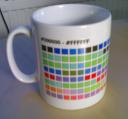
A while ago I blogged about Pantone mugs. At Web safe mugthe time I cracked a cheesy joke about having a mug that was Web- and dishwasher-safe and, guess what, my dream has come true. Nottingham-based Good for Geeks have waved their magic wand and created a mug with all the Web safe colours on it. To say thank you for giving them the idea they have even given me my own complimentary mug (pictured). If you want one, though, I’m afraid you’ll have to pay for it.

Tech Bubble 2.0 – the anthem

December 5, 2007

Here is a laugh out loud, satirical YouTube video by Richter Scales on the dawning Web 2.0 technology stock bubble that has come via Kara Swisher of the Wall Street Journal.

I suggest that you are not eating lunch or sipping hot coffee from a mug when you hit play. It could get messy!

How many scientists does it take to change a light bulb?

November 29, 2007

A twist on the old joke may now have a more formal answer. I was recently pointed to a paper The Increasing Dominance of Teams in Production of Knowledge, published in Science magazine, which looks at the size of teams involved in the production of new research. The authors, Stefan Wuchty, Benjamin Jones and Brian Uzzi reviewed the authorship of 19 million papers produced over five decades to see if there were any patterns.

What they claim to have found is a move from the lone artisan to larger teams of researchers. This was the case not only in science and engineering, where there are obvious, practical drivers to move towards teamwork (shared use of expensive equipment for example), but also, to a lesser extent, in social sciences, humanities and arts. The lone genius battling against the prevailing consensus is a powerful image in the history of science: think Darwin or Einstein. What these researchers are arguing is that they don’t believe this is the case any longer.

But is this accurate? I have to confess I’m a bit worried about this piece of research, partly because the authors only look at (predominantly US) research papers and patents and don’t take account taken of, say, the impact of funding regimes or the ‘politics’ of producing papers. I suppose what it boils down to is that, for me, if you wanted to investigate the question that the research purports to shed light onto, you’d have to do a lot more than add up the number of contributors to academic papers and show that this number has increased over the years. Still, the Wisdom of Crowds tribe will love it and I dare say we’ll hear a lot more about the paper from that quarter.

And the answer to the joke? According to the statistics given in the paper it’s 3.5.

Pantone Mugs

September 5, 2007

Sometimes, whilst flicking idly through a trade magazine, a product catches my eye that just makes me laugh out loud with a burst of geek joy. The people I share an office with usually raise their eyes from their screens just long enough to acknowledge me but not enough to encourage me. So rather than being indulged by my colleagues who, I suspect, just don’t appreciate my sense of humour, I thought I’d blog about it: Pantone mugs.

Each bone china coffee mug is adorned with one of just ten Pantone colours, complete with the associated code, for example Royal Blue 286C. The mugs are produced by W2 Products and you have to see them to appreciate the effect. You can read all about them on their website including the news that they can all be dishwashered safely except the Pink 239C mug. If you work in Web design, illustration or another related industry what could be better for the office?

This got me thinking. A long, long time ago I kept a Pantone swatch card on my desk which listed the code numbers for the restricted list of 216 colours (there are actually thousands of Pantone colours) that had to be used on the early Web. The reason for limiting the colour spectrum on the Web was due to the browsers’ widespread adoption of something called the Netscape colour cube which defined the ‘Web safe’ colours. Perhaps the W2 company should consider producing a limited edition range that is both fully Web and dishwasher safe?


Follow

Get every new post delivered to your Inbox.