Archive for the ‘Technology’ Category

A new Apple drops from the tree

July 2, 2007

The Apple iPhone went on sale in the States this weekend. Over half a million were sold. This is rather a lot—roughly equivalent to one iPhone per head of population of Washington DC and more than twice the expected level of sales.

The reason why there is so much excitement about it is that the iPhone attempts to marry a mobile phone, iPod and handheld computer, with Apple’s “celebrity gadget” appeal. The blogoshere is a-hype with instant reviews, videos etc. (Engadget’s video, for example, was one of the first to show a demo of the working product) and already there are the first signs of a backlash. Concerns are being raised about the speed of Internet access (it uses what is known as 2.5G or EDGE mobile phone access for data transfer—an older, slower version of the 3G system common in Europe), battery life, and the cost and quality of the contract with AT&T, who are providing the telecomms part of the deal (see, for example, New York Times review).

Despite these concerns it does seem to offer a new and exciting platform for accessing the Internet whilst on the move. Steve Jobs gives an interesting insight into his company’s thinking on the iPhone in a hour-long, and under-reported, interview which took place in June at the Wall Street Journal’s D5: All Things Digital conference (which is available through ZDNet as a video). He describes the product as offering three key things: a cell phone, an iPod and “Internet in your pocket”. To me the latter is by far the most interesting.

Here’s why. To date all efforts by mobile phone companies to offer the Internet whilst on the move have been widely derided. The screens are too small, the browsers are not fully featured and the phone companies have often attempted to control (and charge for) access to content (known as the “walled garden” approach). As Jobs points out in his interview, people don’t want this—they want full, unadulterated Web access. The iPhone claims to provide this, with a large screen and a full version of Apple’s Safari Web browser.

Internet access is provided either by WiFi (when in range) or the mobile phone data network. The device allegedly switches seamlessly between the two depending on what’s available. The speed may be an issue when using the mobile phone data network, but perhaps less so in Europe, where the device is likely to be 3G from day one. Incidentally, though, I can’t help wondering whether European mobile phone companies will want the automatic switch from 3G to Wifi, as the need to recoup revenue spent on 3G licence fees is a major issue for them.
Facebook Professional

June 28, 2007

Back in March I wrote that Reuter’s had announced plans to develop a corporate version of MySpace for people who work in finance. I said at the time that we might shortly see a rash of ‘grown-up’ uses of Web 2.0-style social networking. This does seem to be happening, and it looks like Facebook is stealing a march.

One of the interesting things about Facebook is that, according to Mark Zuckerberg, its co-founder (see video), its fastest growing segment is the 25+ age group. Facebook seems to be attracting an older, professional user and, indeed, there has been a slew of articles in the press over the last couple of weeks lauding the professional uses of Facebook, with the Observer calling it the current “craze du jour”. Why is this happening?

Firstly, and perhaps ironically, MySpace, which is owned by media giant News International, seems to have dropped the ball with regard to getting journalists to join and use the service. Journalists write technology stories, which readers follow up.

Facebook, for example, hosts the National Union of Journalists, and the BBC’s Facebook work group has over 13,000 members (and only employees with a BBC email address can join). Facebook claims it has over 500 groups for “journalism” although the vast majority are either student journo class groups or the less than serious, “Blondes for better journalism” (47 members), for example. A quick search of MySpace groups using the same term gave me 45 results and, as far as I can see, none (please correct me if I’ve missed something) are serious, professional networks.

Secondly, there has been a huge interest in the potential for innovation that is provided now that Facebook allows third-party programmers to add their own widgets through its Platform development system. These small applications can be made available to any user on Facebook and can even be revenue generating—what The Register calls a “social networking operating system”. High profile and media oriented developers of such widgets include Forbes and the Washington Post. Such a move is in contrast to MySpace, which has been reluctant to allow completely open access to third-party developers through their service.

But Rupert is aware. The Wall Street Journal reports that when asked whether newspaper readers (who tend to be older) were going to MySpace he replied: “I wish they were. They’re all going to Facebook at the moment”. No doubt there will be an impressive response shortly.

SOA in the movies

June 19, 2007

I was in Birmingham a couple of weeks ago for a series of talks on Service Oriented Architecture (SOA), an approach to IT that is gaining prominence, particularly in corporate environments. There is growing interest in the education sector and the event was organised by UCISA (Universities and Colleges Information Systems Associations).

SOA is a complex concept to get across and requires a rethink of the way an organisation delivers its information services. As part of the day there was an opportunity to see the explanatory animation that JISC have produced. This Quick Time movie provides an excellent introduction to the subject that just about anyone involved in IT will find helpful and be able to grasp.

The coffee table surfaces as Microsoft’s next Big Thing

June 1, 2007

When you think about it, using a computer is quite a solitary experience. Personally, I think there’s a lot to be said for that, but bearing in mind that we operate in a working world that is increasingly about collaboration, team working and group brainstorming, sitting on your own in front of a smallish screen could be seen as rather anachronistic.

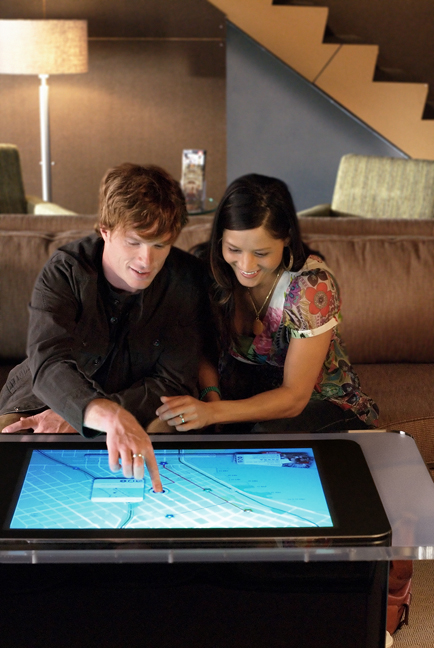
Bill Gates promised back in November last year With Microsoft Surface, you can plan a day of sightseeing without leaving your hotel lobby.that the next revolution in computing would not be the further development of the Web, but rather the manner in which we actually interact with computers. The first fruits of this were announced yesterday with the launch of Microsoft Surface, a coffee table with a built-in PC and touch-sensitive screen that several people can interact with at the same time.

Although this follows in the footsteps of Apple’s announcement of the touch-screen iPhone, what’s particularly interesting is the potential for multi-user activities. For sometime now, researchers, particularly in high-end activities like particle physics, have been experimenting with group working using wall-sized displays. The Surface may bring these kinds of activities down to less esoteric domains such as the average office, school or restaurant.

It’s not only fingers that will be used to interact with the display. Microsoft is keen to explore the potential for interaction between physical objects, for example, using RFID tags. The Microsoft press release cites a futuristic scenario where a wine glass triggers the display of information about the wine’s vineyard. However, from the coverage I’ve seen it’s not entirely clear what would happen if you actually used it as a coffee table and just put down a steaming hot mug of coffee and a plate of biscuits.

Starter for ten: what would a post-Google search engine look like?

April 16, 2007

Bamber Gascoigne, the original presenter of University Challenge, is back in the news this weekend. Since 1994, when he turned down the opportunity to present the new series of the quiz show, Bamber has been working on a history-based search engine. All has finally been revealed, and Timesearch has just been released.

The tool is an aggregator, and it allows users to collate information from various sources (Google, Wikipedia etc.) by selecting various search criteria: geographical location, date etc. I’ve not had chance to play with it at length but there does seem to be a large number of potential options.

The tool is billed on their website as an “early example of the post-Google generation of online search tools, capable of being more finely tuned to the individual needs of the user.” This may be the beginning of a new trend, as people look for more focused ways of finding information. And who better to trust with building the next generation of Web search engines than the man who knew the answers to all of University Challenge’s ‘starter for ten’ questions?

What cost, software innovation?

April 4, 2007

Much fun has been had of late by the anti-Microsoft brigade as the new $9 billion Windows operating system release, Vista, has hit the desktops. There have been concerns about the cost of the UK licence, worries about the general uptake within the business community and reports of incompatibilities with software drivers.

A particular point that is being raised a great deal is that Vista requires some serious ‘beef’ when it comes to hardware. Many users will need to upgrade. Indeed, environmental campaigners have raised the amount of potentially unnecessary dumping of old computers (old as in last year’s) as an issue.

What’s the response from Microsoft? Well, Andrew Herbert, speaking at last week’s jubilee event (see previous blog entries) made an interesting point. He said that new software and operating systems are planned so that they can still be in distribution in six or so years’ time and that system designers are forced to think carefully about what future hardware will be capable of. This is why new operating systems are often quite ‘clunky’ when first released: they are pushing the technical limits of current PCs (processor, memory etc.) with the knowledge that Moore’s Law (of ever-increasing computer power) will be able to deliver the goods in a few months’ or years’ time.

I’m sure this is scientifically and technically true and it’s a view that fits with the history of the personal computer. But I think it raises a question. After thirty years should the computer industry continue to prioritise software innovation over making use of previous generations of hardware? This is perhaps particularly true as more and more applications are performed as services over the Web. This sets operating systems designers a challenge: can they design more backwards-compatible systems that work really well on new kit but are still adequate on older machines?

Will Freeview be able to provide High Definition TV to the public?

March 23, 2007

Wednesday was budget day. Thankfully lunch was not taxed, but one little-noticed item could cause serious debate amongst technology types.

Digital TV delivered by the FreeView system makes use of a portion of the radio spectrum. With the switchover from analogue to digital TV there is an opportunity to re-jig the way the radio spectrum is used and, in the process, release some spare capacity. This spare spectrum is known in technology circles as the ‘digital dividend’.

So why is this important? Well, buried on page 151 of the Budget Report, the Government notes that, through its agency Ofcom, it is consulting on a proposal that the “spectrum released by switchover should be auctioned on an open basis during 2008-9”.

Herein lies the rub. Note the word ‘open’ in the Budget report. The Government is suggesting that this ‘digital dividend’ could be auctioned off in a process similar to the radio spectrum auction that took place a few years ago, when the Government made billions auctioning spectrum to phone companies for 3G mobile phone capacity. Yet it is this ‘spare’ capacity that is partly needed if Freeview is going to be able to deliver High Definition TV as a free-to-view service.

Such an auction might end up with prices that no public sector broadcaster could compete with and therefore effectively freeze out Freeview from the next generation of spectrum capacity. This could be a problem for the millions of people, who, anticipating the great switchover, have invested in a nice, shiny, new HD-ready TV. If an open sell-off happens, there’s a good chance that they won’t be able to get HD TV pictures over free-to-view services.

Second Life and the 3-D Web

March 21, 2007

I spent yesterday afternoon at the eBusiness Expo 2007 which was held on my home turf of Nottingham. Lunch was a buy-your-own sandwiches affair which I’m afraid doesn’t win any prizes for originality. The main talk of the afternoon was from Danny Meadows-Klue, from the Digital Training Academy, on how to use Web 2.0 technologies for marketing purposes. On the whole, the talk was a fairly reasonable trot through the different areas (social networking, RSS, podcasting, mash-ups etc).

There was one point, though, where Danny and I parted company. He doesn’t think Second Life is worth much attention and I’m afraid I have to disagree. If you look at what is likely to be the next step in the development of the Web it is in advanced, 3-D graphics. IBM are investing money in a project to take the visual ideas behind Second Life and transplant them to the Web and Tim Berners-Lee, speaking at last year’s WWW2006 conference, indicated that he thought advanced graphics were the next stage in the Web’s development. Second Life may only be a ‘dry-run’ for a more visually arresting Web, but if you’re interested in where the Web is going, then Second Life is currently the easiest way to explore the implications of 3-D at an early stage.

Penguins

March 9, 2007

It is often said that given enough time and a couple of typewriters a room full of monkeys would eventually come up with the complete works of Shakespeare. What about a group of penguins? Or more precisely, 1,500-odd Penguin books readers?

Penguin books have been working, in collaboration with De Montfort University in Leicester, on a Million Penguins, a collective, novel-writing project using a wiki. Over 1,500 people have contributed and editing on the book closed on Wednesday.

This is another example the way in which the Internet can be used to harness the power of the crowd to produce collective works. I think it’s interesting as an example of the idea moving into a new domain: novel writing, although I’m not sure how readable it is. I have to confess I didn’t get too far as there are well over fifty characters to keep track of.

The idea, though, of being able to see a list of the characters each with a wiki page of information may well catch on back in the real world of book publishing. How about an online version of a paper book with this kind of additional – dare we say meta – information?

Scotch Spam

March 8, 2007

Unkind people have been known to make jokes about a Scotsman and his wallet, but what about his email in-box? According to spam activist group, Scotch Spam, Gordon Dick, a marketing specialist from Edinburgh, has successfully sued an email marketing company for sending him unsolicited spam. In a story that was first picked up by Associated Press, Mr Dick won £1,368.66 (plus interest) in the Edinburgh Sheriff Court. To achieve this, Mr Dick made use of the UK’s Privacy and Electronic Communications Regulations 2003.

I think this interesting because, according to Scotch Spam, if all the thousands of recipients of the same spam message had also sued, then the total bill would be more than £54 million. Despite many technical innovations spam still remains a huge problem for the Internet – perhaps resorting to the law, and the power of the crowd, is the answer.