The bloggers at Creative Nottingham have a fine summary of last night’s Nottingham Festival of Words launch.
Archive for the ‘Technology’ Category
Festival launch update
September 13, 2012Nottingham’s new Literary Festival
September 10, 2012On Wednesday evening I’ll be at Antenna media centre in Nottingham, doing a quick spot at the official launch of the inaugural Nottingham Festival of Words. It’s a taster for my full session, which takes place in February 2013, where I will be talking about the new science of the Web and exploring some of the stuff there wasn’t space for in Web 2.0 and Beyond. Unfortunately I gather that there are no tickets left, so I can’t invite anyone, but I’ll post a summary later this week.
MOOCs
August 7, 2012How many people might get to see a particular university lecture? The biggest academic halls hold a few hundred students. If the talk is more or less repeated every year then this might tot up to a handful of thousands in the entire career of a lecturer. How then about the idea of reaching out to a million?
The flattening of the globe which was so powerfully explored by Thomas Friedman in his book, The World is Flat, is coming to the fusty old world of the university lecture. Leading institutions are scrabbling to get on-board the latest educational technology vehicle, massive open online courses or MOOCs.
Using the power of Internet video technology these services offer university-level lectures to anyone with a computer and broadband, anywhere in the world. The leading proponent is Coursera, a US for-profit social enterprise which provides free online courses in a range of subjects and themes from the human genome to algorithm design.
The service launched in April with a small, but blue-chip, selection of US universities, but the University of Edinburg announced last week that it is joining the scheme and offering courses including an introduction to Astrobiology and Extra-terrestrial Life.
It is part of a wider move to what are being called open educational practices, offering as Edinburgh’s Jeff Haywood describes it: “ways to flex and bend the constraints that much of our traditional HE formats impose on us, and on our learners.” Or as Tim Berners-Lee put it at the Olympics opening ceremony – “This is for everyone.”
What is a troll?
June 14, 2012It makes for a cracking headline, but Internet ‘trolling’ is not the abusive behaviour that has been reported in various newspaper articles this week.
Subs from both the Guardian (‘Internet troll told by court to keep away from public figures’, 12 June) and the Telegraph (‘Trolling abuse got worse for victim Nicola Brookes after Facebook victory’, 11 June) have had fun with this word in the last few days.
The truth is though that the word ‘trolling’ has been widely used in Internet circles for years to refer to the act of tying up online forums, and other social media, in meaningless and time wasting discussions. The idea is to post something that is deliberately incorrect and lure other users, particularly newbies, into wasting time arguing about it. According to net scholar Susan Herring and colleagues at Indiana University it derives from a fishing term whereby a baited line is dragged behind a boat (see an example paper here).
The behaviours described in the newspapers are more accurately described as ‘flaming’, or more succinctly, just abuse.
Saddle Up the Pono
June 7, 2012“I feel like more than just a number.”
Neil Young, Computer Age, (track from the album Trans)
For many years, rock musician Neil Young has been highly critical over the move to digital formats. His beef is simple enough – the digital formats in use today lose too much of the music; MP3 for example only retains about 5% of the data from the original mix. Many people claim this is irrelevant as they can’t hear the difference, but to a musical purist like Young, they are missing something important from what he has created.
Recently he told Walt Mossberg, in an interview for the Dive Into Media conference, that his solution is an ‘iPod for the 21st century’: a new player and a new format that “some rich guy” would produce. He then revealed that he had been talking to Steve Jobs, just before he died, about such a device.
It was later revealed by his publisher, perhaps inadvertently, that the device would be known as a ‘Pono’ and Rolling Stone magazine have found that various trademarks, such as SQS (Studio Quality Sound), have been registered.
In an interesting development, when I pre-ordered the latest Neil Young album (on vinyl of course) I was sent a free, digital download track. It came in the Free Lossless Audio Codec (FLAC) format, which is open source and can handle 24-bit audio: the same resolution at which most bands record their albums these days.
My impression from the interview with Neil Young is that he’s not convinced that FLAC is quite there as the ultimate digital format. But no doubt the quest goes on and once again, Apple are the one to watch.
Chinese Social Media
May 24, 2012
One of the interesting aspects of research for the book was finding out more about how social media is used outside the West. In particular, there is a huge, and mainly homegrown, Web 2.0 environment in China. Services such as QZone, RenRen and CyWorld dominate their home market and have hundreds of millions of users.
I was reminded of this a couple of days ago whilst reading about the Facebook IPO. The Guardian published an analysis by technology editor, Charles Arthur, which included the following quote from Ed Barton, a digital media specialist:
“Facebook depends on advertising, and I would highlight that the fastest-growing internet media markets are China and the Far East, India and Brazil. Facebook’s potential is nowhere near as strong in those as it has been in the US. And in those markets there are often a number of locally oriented social networks already in place.”
With billions in the bank from its IPO, the normal route to expansion for Facebook might be a major purchase in one of these emerging markets. But things are never that simple in one-party-state China. The IPO may have run into local difficulties in the last few days, but the battle for Chinese users is a longer term strategic challenge for the company.
Web 2.0 and Beyond is published
May 18, 2012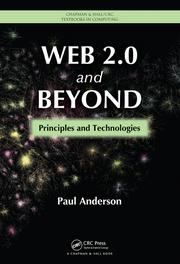 A couple of years ago I was approached by an American publisher about the possibility of writing a general reference/textbook that covered Web 2.0 and Social Media. It followed on from the success of a report I wrote for JISC in 2007, which was written for both technical and non-technical readers, and the publishers wanted something similar, but more of it.
Well yesterday a friend rang to ask if I knew that the ‘buy’ link had been activated on Amazon, so I guess I can say that my book, Web 2.0 and Beyond (published by Chapman & Hall/CRC, a computer science imprint of Taylor & Francis), is well and truly published.
The remit was challenging – CRC were developing a new series, aimed at reinventing the textbook format. Their point was that, increasingly, it is students from business studies, economics, law, media studies, psychology etc. who want to understand what CompSci is up to but who don’t necessarily have the deep technical knowledge to really understand how the technology came to be or what the implications of it are. However, as CRC is primarily a computer science imprint they also didn’t want to compromise on the requirements of their primary audience.
I was particularly interested in this idea because studying social media is increasingly becoming an interdisciplinary melting pot. Also, having taught computer science I was keen for students to have a well-rounded sense of the discipline – that they should have a sense of context rather than just learn how to write code. I could also see parallels with Web Science, the study of the Web as the world’s largest and most complex engineered environment (which at the time was only just starting to emerge), and I thought that if ever there was going to be a moment when it was possible to bring all this together in one book, it would be now.
The tricky thing, of course, was getting it all to come together. With the help of some extremely skilful editing I think what we’ve done is to obey three golden rules: only tell readers what they need to know at that point in time; use narrative techniques that engage the reader and allow them to read through the filter of their own discipline; and to keep highly specialised information (hard-core technical information, overviews of research etc.) in separate sections and chapters.
The framework for all of this is the ‘iceberg model’, which tackles Web 2.0 using a layered approach. The premise of the book is that if you understand the iceberg model you will be better equipped to understand how the Web is likely to evolve in the future. There are, of course, a few pointers as to what that might look like.
In the spirit of Web 2.0 there are also various information sources associated with the book. There’s a YouTube channel where I post information about relevant videos, and you can find out about these if you subscribe to the book’s Twitter feed (@web2andbeyond) where I also post other snippets of relevant information that help to keep the book fresh. More detailed information is on the book’s Facebook page (www.facebook.com/web2andbeyond), which also includes notes and excerpts to give a taste of the narrative style of writing I mentioned earlier.
It has been a while in the making and part of me still can’t believe that it’s actually here, but it is, so now all I need is for people to buy it. Hint hint.
Bubble 2.0?
May 2, 2012My new book on Web 2.0, which comes out later this month, concludes with a brief review of the prospects of us entering a second Internet stocks bubble. Although somewhat forgotten now (eight years is an eon in computing), the original concept of Web 2.0 emerged out of the dot-com crash that followed the Internet bubble of the late 1990s. With the Facebook flotation and recent purchase of Instagram this has become a topical issue, and I was interested to read a piece on GigaOm which reviews the evidence for and against.
 Tech Lunch
Turing: nearly on the money
October 29, 2012Turing statue at Bletchley Park (photo: Antoine Taveneaux, Creative Commons CC BY-SA 3.0)
I’ve long been a supporter of the campaign to put Alan Turing on the back of a ten pound note in recognition of his mathematical achievements. So I was pleased to get an email over the weekend confirming that the national e-petition has reached 21,996 signatures. This is good news for the campaign and as the e-mail from HM Government says:
“As this e-petition has received more than 10 000 signatures, the relevant Government department have provided the following response: The Bank of England has been including historic characters on its notes since 1970. The Bank welcomes suggestions from members of the public for individuals who might feature on future banknotes, and publishes a list of these suggestions on its website. These suggestions inform the process when a new note is under consideration.”
So all good. A glance at the published list, however, shows the competition that our Alan is up against. There must be around 150 names, ranging from philosopher Roger Bacon to singer Robbie Williams (yes, you read that correctly).
More signatures on the petition can only help. Surely the inventor of the founding theory of digital computers can beat the singer of 90s hit ‘Angels’?
Tags:Alan Turing, computer science, e-petition, Turing
Posted in Comment, People, Technology | Leave a Comment »