A proper lunch

June 25, 2007

As you know, this blog takes a keen interest in the status of lunch in the modern working environment. So I was delighted to read the following comment by scriptwriter Andrew Davies in yesterday’s Observer magazine (you’ll need to scroll to find the article, entitled Andrew Davies and Kate Lewis):

“I don’t really like working with anybody who doesn’t do lunch. It doesn’t have to be a grand lunch but it has to be a proper lunch with wine… There is a move in TV to do away with lunching which I’m passionately opposed to!”

Epicurean respect.

Cambridge

June 20, 2007

I enjoyed last week’s meeting of East Anglia Online User Group (EAOUG) at the Royal Society of Chemistry. There were several interesting speakers from the library world talking about ways in which technology was changing their working practices and introducing the need to learn new skills. Some of the presentations are now available online at the group’s website.

There were some interesting discussions and I learned a lot about some of the everyday realities of working with new technologies in libraries. There was a definite feeling that an issue for library staff is a developing ‘digital divide’ between the younger users, who are steeped in technology and have expectations as to its use, and the staff, who tend to be older and have less time to learn about new things. One delegate recounted how she had resorted to using Facebook in order to contact a young borrower who had failed to return a textbook as all other forms of communication, even email, had failed. Several people concurred in the view that students, in particular, viewed email as rather old fashioned!

As ever, a quick note on the lunch. My offline feedback is that I don’t devote enough time to lunch and that I need to try harder, so here goes. You may remember that I was a little bit worried about how far the Royal Society of Chemistry might go in the preparation of lunch. As the clocks on the wall had chemical symbols instead of numbers I was concerned that this might demonstrate a rather unhealthy interest in all things chemical. However, I’m pleased to report that this was not reflected in the either the choice of ingredients or the means of preparation. Lunch, in fact, consisted of a tasty spread of sandwiches with an interesting twist – the brown and white bread mixed together on the same sandwich. It’s these little touches that I find interesting. Desert was a platter of exotic fruit slices, so, an overdose of fructose rather than anything less healthy.

SOA in the movies

June 19, 2007

I was in Birmingham a couple of weeks ago for a series of talks on Service Oriented Architecture (SOA), an approach to IT that is gaining prominence, particularly in corporate environments. There is growing interest in the education sector and the event was organised by UCISA (Universities and Colleges Information Systems Associations).

SOA is a complex concept to get across and requires a rethink of the way an organisation delivers its information services. As part of the day there was an opportunity to see the explanatory animation that JISC have produced. This Quick Time movie provides an excellent introduction to the subject that just about anyone involved in IT will find helpful and be able to grasp.

Speaking on Web 2.0

June 11, 2007

I have been invited to speak about Web 2.0 at the “Managing New and Emerging Library Technologies – Skills for the 21st Century” event being organised by the East Anglia Online User Group (EAOLUG).

The event takes place on Wednesday at the Royal Society of Chemistry so I’m hoping for a lunch in the style of one of these molecular gastronomy chefs like Heston Blumenthal. Then again, of course, it could just involve lots of sodium chloride or be something a bit weird like potassium permanganate on toast.

Strategic Lobsters

June 7, 2007

Yesterday I was in London, for an invited workshop on horizon scanning for strategic futures planning, courtesy of the DTI’s Office for Science and Innovation. Horizon scanning is a process of trying to anticipate the future through, to quote the Chief Scientific Advisors Committee, “the systematic examination of potential threats, opportunities and likely developments including but not restricted to those at the margins of current thinking and planning.”

This kind of technique is becoming more widely used in government circles. There has been a particular interest in it from those departments with an interest in science, especially after the BSE farming crisis and the perceived mishandling of the GM foods debate. Indeed, chatting to delegates over coffee, who were mainly from various government departments, it became clear that civil servants are being increasingly asked to move away from their traditional job of purely drafting policy. They are being asked to work in ‘delivery mode’ and act not only to manage projects, handle finances and deal with risk analysis, but also to have input to strategic decisions on future directions for government.

The event was held at a superb venue, the Founders Hall, home of the Worshipful Company of Founders, one of the thirty or so Companies of the old London City, dating from the 1500s. I was interested to see that hung above the porcelain in the toilets were framed examples of dinner menus from meetings of the Founders in the 1930s. These listed delights such as Lobster casserole au Chablis, Passion Fruit Sorbet and Grouse Pudding. I was therefore pretty upbeat about the prospect of lunch. Sadly, the nice, but unadventurous ricotta and spinach lasagne that was offered to vegetarians did not quite match my expectations. Although they did serve coffee with liquorice allsorts, something I’ve not come across before.

The coffee table surfaces as Microsoft’s next Big Thing

June 1, 2007

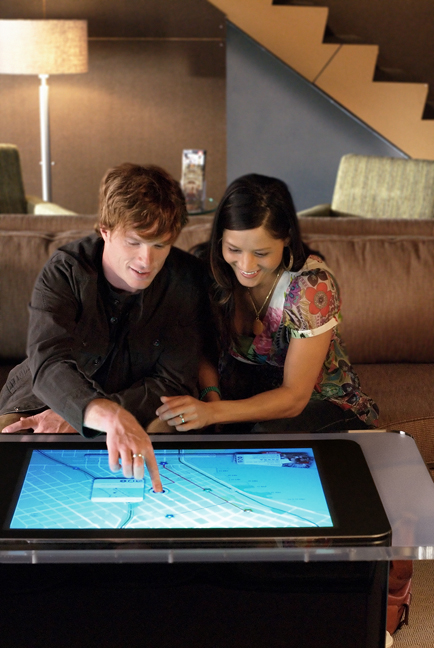
When you think about it, using a computer is quite a solitary experience. Personally, I think there’s a lot to be said for that, but bearing in mind that we operate in a working world that is increasingly about collaboration, team working and group brainstorming, sitting on your own in front of a smallish screen could be seen as rather anachronistic.

Bill Gates promised back in November last year With Microsoft Surface, you can plan a day of sightseeing without leaving your hotel lobby.that the next revolution in computing would not be the further development of the Web, but rather the manner in which we actually interact with computers. The first fruits of this were announced yesterday with the launch of Microsoft Surface, a coffee table with a built-in PC and touch-sensitive screen that several people can interact with at the same time.

Although this follows in the footsteps of Apple’s announcement of the touch-screen iPhone, what’s particularly interesting is the potential for multi-user activities. For sometime now, researchers, particularly in high-end activities like particle physics, have been experimenting with group working using wall-sized displays. The Surface may bring these kinds of activities down to less esoteric domains such as the average office, school or restaurant.

It’s not only fingers that will be used to interact with the display. Microsoft is keen to explore the potential for interaction between physical objects, for example, using RFID tags. The Microsoft press release cites a futuristic scenario where a wine glass triggers the display of information about the wine’s vineyard. However, from the coverage I’ve seen it’s not entirely clear what would happen if you actually used it as a coffee table and just put down a steaming hot mug of coffee and a plate of biscuits.

How sustainable is open source software?

May 31, 2007

There has been a significant upsurge in interest in the use of open source software (OSS) solutions in recent years in both the private and public sector. Education, due to its specialist nature, is particularly interested in OSS for delivering IT solutions in areas where it feels that traditional, closed source solutions have not always catered for its needs. Prominent examples include the Moodle e-learning environment, the Sakai collaborative learning environment and DSpace, a digital content repository system.

One of the big debates to date has been the question of how sustainable open source solutions are likely to be in the long run. The popular image of open source is that a disparate group of software hackers come together in a fairly ad hoc manner, and, usually led by a charismatic figure (or ‘benevolent dictator’) like Linus Torvalds, produce some software. In time, the people involved will go off and work on other, newer, perhaps more interesting projects. This is a worry for education, which needs the reassurance of long-term stability. Questions arise such as who will be maintaining this code, can I read a manual, is there an O’Reilly book, who amongst my staff will understand the programming language that’s been used? These are timely questions and a project that I’ve been indirectly involved in, which attempts to deal with some of these issues, has just come to fruition. Oxford University’s OSS Watch service have announced the publication of their report, “Sustainability Study: a case study review of open source sustainability models”.

If you’re interested in OSS but have previously felt it was too ‘techie’ for you, then I’d recommend this report. My colleague, Gaynor Backhouse, did the editorial on this and I know she was keen to really tell the ‘stories’ involved in order to provide context for the issues and make them more accessible. It was an interesting project to work on, not only because of the subject matter, but also because it involved, in effect, interviewing some of the key figures in OSS development. We joke about it being ‘extreme journalism’, in the style of extreme programming, as there was an iterative process of development and checking with authors. It is, however, quite a long report (around 60 pages) but it is divided into chapters, so you can dip in and out of it as it suits you.
Can MySpace drive urban regeneration?

May 8, 2007

I’m based in Nottingham, an English city which has not been without its problems in recent years. Its reputation has not been helped by a slew of sloppy journalism which has failed to make accurate comparison with the situation in cities of comparable size. I’m pleased to be able report though that the good folk of Nottingham are fighting back and trying to emphasise the positive things that go on in what is a culturally dynamic city. There’s been a tremendous amount of regeneration and rebuilding in recent years culminating in the city being named as one of six Science Cities in the UK. A lot of this work has taken the form of large-scale projects such as the creation of a bio-technology business centre (Bio-City) and the redevelopment of what’s called the Eastside.

But I’m a great believer in keeping an eye on the below-the-radar, small-scale stuff, especially when it involves clever use of new technologies. AreaFour Recording Industries is one such small regeneration project – a not-for-profit record company being driven by staff from the local area partnership that is bringing together un-signed music talent from across the inner city and helping to promote them to the outside world. They’ve just released a CD, called SoundCheck Nottingham, with eighteen bands, samples of which can be heard at their website.

I declare an interest here, since I have known Alan Carter-Davies, the project manager and producer, since we worked together on a technology transfer project in 2001. But I don’t plug people just because I know them. What interests me about the AreaFour project is how they’ve used Web 2.0, and in particular the MySpace social networking service. The project used MySpace to help find and bring together musicians and Alan told me “I set up my own MySpace account and started trolling for Nottingham-based guitar bands there. I found at least half the bands through MySpace and without it the job would have been a lot harder. All the bands have areas within MySpace and there is a lot of linking between them and other musicians”.

Cities are as much social constructs as they are physical ones where our social relations are as important as the buildings and streets. Urban renewal is surely as much about rebuilding the links between people and communities as it is about shiny new plate-glass buildings along the canals. Maybe there is a role here for social software like MySpace, acting as a reconnection tool, working as an adjunct to regeneration? MySpace is known for its young user group and, well, frankly its triviality. But maybe it could have a more important role in helping to build communities. Suzanne Moore writing in last week’s NewStatesman about the atomisation of our culture in recent decades called for us to a create society that insists on “OurSpace in a world of MySpace”. Perhaps it is already happening, and not in the way she imagines.

Taking tea with e-assessment strategists

April 26, 2007

I spent yesterday in central London at a joint meeting between JISC and the Higher Education Academy. The aim of the event was to explore ways in which the two bodies, who both have responsibilities for differing aspects of Higher Education, could collaborate strategically. The discussions focused on e-assessment: the process of using more automated and computer-based methods for measuring student attainment, progress and testing. Of interest to me were the debates around the use of new technologies in these areas and in particular discussion of the potential for Web 2.0 and social software.

This throws up interesting issues, for example, if a class works together on a wiki about a subject, how can the marks be divided up fairly? One speaker pointed out that different subjects have different views on the use and uptake of automated assessment, explaining that, for example, Philosophy lecturers have not, to date, seen the benefit of using such methods as they rely so heavily on the essay as a form of assessment. Other speakers took up this theme and argued that although this was an issue it was at least partly because too many academics see e-assessment as being all about the use of what is called in the jargon MCQ (or ‘multiple choice’ to you and I).

The venue for the event was the magnificent, neo-classical, One Great George Street, just a stone’s throw from the Houses of Parliament (although stone throwing is not actually allowed, for obvious reasons). The venue is partly home to the Institute of Civil Engineers and they had laid on a reasonable lunch including roast vegetable frittatas and chocolate fudge cake. However, I was most impressed by an exquisite range of herbal teas from the Mighty Tea Leaf Company which came in an interesting range of flavours and each in a large muslin pouch (rather than a mere paper bag) which contributed to an enhanced brew. As far as I can see from their website they are not fair traded, so I won’t be able to justify buying them, but if you ever come across them at functions or tea shops I can recommend the green tea.

I have to say that I was rather surprised and pleased to find such attention to tea detail at the Institute of Civil Engineers, as, generally speaking, civil engineers are not renown for their appreciation of fine tea. Is this a sign of changing times?

John Backus

April 20, 2007

It’s not often that a computer scientist makes the obituary column of national newspapers. So it’s interesting that the death of John Backus, the inventor of the Fortran programming language, made it into the Guardian and New York Times recently.

Anyone who is old enough to remember struggling through scientific programming classes using Fortran 77, will perhaps recall cursing the inventor of a language more orientated to the days of the punch card. However, Backus should be remembered for introducing the basic concept that machines could be programmed using English-like notation rather than an impenetrable stream of numeric codes (as was the case at the time in the early 1950s). The first version of the Formula translation (Fortran) language appeared in 1957 and the British Computer Society recently celebrated its jubilee. It’s still going strong, indeed work is under way on Fortran 2008.

Backus’s work led onto a plethora of other high-level languages such as Pascal and Java. This brings to mind the infamous real programmers don’t use Pascal letter which first appeared in Datamation magazine in 1983. This was a tongue in cheek computer science version of the ‘real men don’t eat quiche’ phenomenon. In a time when there was a concern amongst some that computer languages were becoming a bit, well, easy, this was a hacker’s attempt to separate the wheat from the chaff. It included lines like: ‘Real Programmers aren’t afraid to use GOTOs’ and ‘Real Programmers don’t need comments– the code is obvious’.

The letter also contains the immortal line:
‘Real programmers arrive at work [just] in time for lunch’.