If hungry Then pizza

December 12, 2011

For some time I’ve been thinking about a device that silently measures my growing hunger pangs and, when they reach a pre-defined threshold, automatically orders a hot veggie pizza from our local delivery shop. Pizza would be on the office doorstep just as my brain is deciding it’s time for lunch.

This of course is part of the vision for the Internet of Things. Perhaps not the pizza scenario per se, but the idea that ordinary, every day appliances and gadgets will be hooked up to the Internet and start communicating with each other. So far, one of the obstacles has been how to connect devices with software services, which in turn communicate with other devices.

Thanks to a heads-up from a friend I’ve been playing with one possible solution. If This Then That (or ‘IfTTT’, pronounced as ‘lift’ without the ‘l’) is a website that allows the user to build Web service ‘recipes’ in which online tasks are triggered by actions. So, for example, I’ve just created a recipe that will send me an e-mail when the weather forecast starts to warn of rain. Other examples include an SMS alert when someone uploads a photo to Facebook that has been tagged with your name.

The data that initiate these triggers and actions come from ‘channels’ and at the moment these are the usual Web 2.0 suspects – Twitter, Facebook, Foursquare, weather services etc. So far it’s fairly basic stuff but hopefully you can see the potential. The number of channels could be expanded to include the kind of Internet-enabled devices that would re-categorise the Internet of Things from pipe dream to killer app. We could have fridges co-ordinating electricity consumption with kettles, or even responding to an external service that triggers switch on/switch off actions in response to the load on the National Grid. Indeed, another website, Pachube, already provides some of the software infrastructure to do aspects of this.

Surely this is a marvellous time to be one of those cubicle jockeys who toil away for Internet start-ups? Any day now that age-old techie conditional statement will be automated:

IF hungry THEN order pizza ELSE carry on programming.
Curating Scholar

November 30, 2011

Thanks to a heads up from Brian Kelly, I’ve been having a look at the latest improvements to Google Scholar, a search engine for academic papers that served me well whilst writing the Web 2.0 book. The thing that caught my eye was that the site now allows authors to curate a collection of their papers and calculate the number of citations each one has had.

The citation figures for my authorial output follow the classic ‘long tail’ distribution in which one or two papers receive a large or moderately large number of citations and the rest each receive a handful. I was pleased (and a little surprised) to see that the Web 2.0 report I wrote for JISC back in 2006 has received almost 600 citations in the intervening years. I knew that the report had consistently been the most downloaded document on the website (over 100,000 in the first three years), but I’d assumed that a lot of this traffic was due to students preparing course work, particularly as the stats rose during term times. However, it seems researchers have also picked up on some of the ideas, which is rather reassuring as when I was writing the book I had to fight my corner to get a detailed look at the state-of-the-art in research included. Let’s hope this bodes well for sales.

Now the iPad can measure your vital signs

November 18, 2011

How excited do you get playing with your iPad? Would you give up your lunch hour to spend a few precious moments staring into its ten inches of LCD loveliness? Philips thinks there are plenty of us who would, and they have developed the VitalSigns app to provide us with an excuse – if we feel we need one.

You place your iPad on a table, set the app running and then just look at the screen. The iPad’s camera tracks tiny colour changes in your face – undetectable to the human eye – and equates them to heart rate. It also detects the movement of your chest to calculate how fast you’re breathing.

The disclaimer says that the app is strictly for fun – you can email the results or post them to Facebook or Twitter – and that readings are not intended for diagnosis or clinical monitoring or decision making. While this may sound a trifle strange, in the wider world the app is part of an emerging trend of self-measurement. There is, according to a recent article in MIT Review, a growing movement of ‘self trackers’ – fitness fanatics, geek obsessives and the genuinely ill – who are using an array of new gadgets to obtain near-constant feedback on their health. Building on techniques used in sport and hospital intensive care wards, these devices allow the user to monitor, record and analyse different health-related functions.

Of course we shouldn’t be surprised. Smart meters that report back details of our energy use are now old news, even if we haven’t quite got round to installing them yet. The Philips device and similar self-tracking systems are just part of the first wave of technology that feeds data back to us.

Raspberry Pi, but not for lunch.

November 11, 2011

There have been whispers about the Raspberry Pi über-mini computer for several months now, but in recent days the project has come out of skunk works and is garnering some press attention. Essentially, the plan is to design and build a credit card-sized, programmable computing device for as little as $25 (around £15). The technology is based around an ARM 11 microprocessor and the GNU/Linux operating system. An SD card provides storage (unsurprisingly at this price there is no hard disc) and a HDMI connection means that a consumer TV can be attached.

The organisation behind it is the Raspberry Pi Foundation, a UK registered charity that wants to put the fun back into studying computing by manufacturing an ultra-low cost computer and distributing it to schools so that they can teach computer programming to children. Genius. In the late 1970s, people like me cut their programming teeth on similar, although much less powerful, single board hobbyist computers such as Nascom and Kim. With the rise of commodity computing, and brands such as Apple, IBM, Dell and Microsoft, these kinds of machines all but disappeared. The Raspberry Pi team are trying to recreate that spirit of adventure, and as one of the developers, Eben Upton, puts it in a YouTube video:

“Young people don’t have a platform they can learn to program on. I’ve been programming since I was ten, most of my friends who are in the industry have been programming since they were ten, [but] there aren’t a lot of ten-year-old computer programmers anymore. This is going to be an enormous problem for our industry.”

The overall aim seems to be to get these devices into schools, particularly in the UK, and there is talk of a scheme that asks every purchaser to donate one to a local school. As the UK’s coalition government continue to scratch their heads over how to get growth going again it could do far worse than look at this scheme to help fire up the imagination of a new generation of coders.

Beyond Web 2.0

November 7, 2011

It has been an awfully long time since my last blog posting.

For those who don’t Twitter me, I’ve been writing a book. It’s called Web 2.0 and beyond: principles and technologies and it’s going to be published in May by CRC Press, the computer science imprint of Taylor & Francis.

I should say that it’s not your usual comp. sci. textbook. My brief was to ‘reinvent the textbook format’ and while that’s quite an exciting thing to do, it’s been a huge undertaking. The underlying premise is that understanding the Web is too big a job for computer scientists alone, and the book looks at where understanding the technical infrastructure behind Web 2.0 intersects a range of other subject areas such as business studies, economics, information science, law, media studies, psychology, social informatics and sociology.

This was not my idea. It was first put forward by Tim Berners-Lee and Nigel Shadbolt in an article for Scientific American in 2008. Since then Web Science, a new, interdisciplinary research area, has emerged. However, using this as a template for a textbook has been hard work: as well as linking to aspects of many different subject areas I’ve had to write the book so that non-engineers can not only understand it, but also find it interesting. So I’ve included some of the history of the Web, both for colour and context, and on the basis that a picture paints a thousand words I’ve developed and refined my ‘iceberg’ model of Web 2.0 (read the original description of the iceberg model in a 2007 JISC TSW report).

Finally, of course, there’s a section on the future (the beyond bit) – or rather, potential futures. By the time the reader gets to this part of the book they should have learned enough to be able to form their own ideas about Web 2.0 and to have an informed opinion on what might come next.

So, a huge undertaking. I’m still a bit dazed – can’t quite get used to the idea that when I get up I have a choice of what to do – but I have it on the highest authority that there is life beyond Web 2.0. All I can say is that there’d better be some pretty good lunches.

Display technologies

June 17, 2011

Back in 2005 I wrote a fairly long report for JISC on the future of display technologies, covering the likes of 3-D TV and holographic imaging. Two of the peer reviewers, Mark Fihn and Wayne Cranton, were particularly helpful.

It appears they’ve not been idle in the intervening years as they’ve just announced the publication of a new book, the Handbook of Visual Display Technology. Weighing in at a mighty 2000 pages in two volumes this is not for the faint-hearted, but it looks like this book represents a substantial summary of this important area of electronics.

The Naked Chef goes 3-D

February 25, 2011

Thanks to the monastic life imposed on me by the demands of writing a book it has been some time since the I had an opportunity for a pukka tech lunch. So I relished the chance yesterday for a business meeting at Nottingham’s new Jamie Oliver restaurant in Low Pavement.

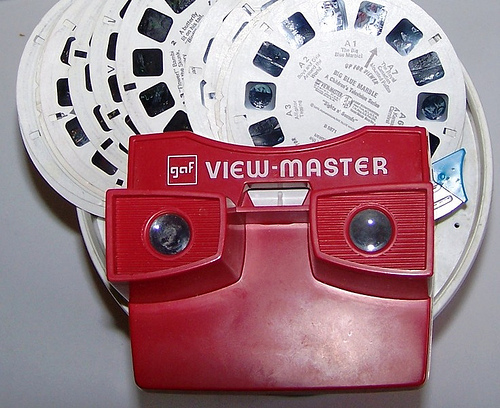
To add to my prandial joy there was the opportunity to view pictures of the dishes on the menu in 3-D using a device called an Image3D. These devices were meant for the kids I think (allowing them to see what they were ordering rather than reading the menu). However, children of my age will remember these toys  – then called ViewMasters – from the 1970s (see picture).

After exploring the technology for a while it was time for the main event. As a lover of pasta I was in seventh heaven and can thoroughly recommend the Turbo Fusilli Arrabiata. Sorted.

View Master (Source: Enokson, licenced under CC BY-NC 2.0)(http://flic.kr/p/7ZELMA)

Richard Stallman in UK

February 18, 2011

He’s back. Richard Stallman, the digital rights pioneer will be presenting his own unique take on free and open source software at events during March in London, Cambridge, Brighton, Sheffield and Preston. If you’ve not come across his work with the Free Software Foundation have a look my report from his 2008 trip to Manchester. All in all a fascinating, and hugely entertaining, evening. Recommended.

Further details: http://www.fsf.org/events/rms-speeches.html

Ken Olsen

February 11, 2011

I have fond memories of the PDP11 minicomputer from my days as an undergraduate in the 1980s. So I was sad to hear about the death of Ken Olsen, the founder of Digital Equipment Corporation (DEC), the company that made the machine. In a society awash with iPads, smartphones and other miniature computing devices it is easy to forget the role that DEC’s minicomputers had in the history of the industry. They provided a bridge between the room-sized mainframes of the 1960s and the invention of the PC, and helped train a generation of undergraduates and researchers.

It was the PC that was DEC’s downfall and unfortunately Olsen is mostly remembered for his failure to spot the evolution of smaller computers beneath DEC’s feet. I however will remember Olsen with gratitude for the hours of pleasure in the computer room at Leeds University, learning to code in ‘C’, and occasionally being distracted by the flash of my mate Punkah’s orange cagoule as we sent each other messages on the computer’s rudimentary email system. Just because we could.

It was twenty years ago today

November 12, 2010

It seems incredible, but it’s true: the Web is officially twenty years old today. Tim Berners-Lee’s original proposal was submitted to his bosses at CERN on this day in 1990. There was apparently little or no initial enthusiasm or, indeed, response. Although years later a copy sent to one of them, Mike Sendall, was found with the following words scrawled on the front cover: ‘vague, but exciting’.

You can read the original at: http://www.w3.org/Proposal.html

Tim Berners-Lee describes the initial efforts in the following video talk: http://data.gov.uk/resources#content-area