Tweeting for Britain

January 19, 2009

Iain Dodsworth, a British Web 2.0 technologist, has just pulled in seed funding for his Tweetdeck application. I’ve been playing about with this recently as it’s a good way to get to grips with Adobe Air – a way of running Web-type applications away from the browser. TweetDeck allows you to split your twitter tweets into streams of content based on groups or topics which you control. Interesting to see that in these benighted times there is still some technology venture capital action. And it’s nice to see that not all Web 2.0 related stuff is being conceived and built in California.

Blog Bandits at 12 o’clock

January 16, 2009

Most people’s view of the air force is probably still pretty tainted by hazy, black and white memories of scenes from the ‘Dambusters’ film. The siren goes, the pilots drop their crosswords and still-smoking pipes and sprint from the officer’s Mess to the waiting spitfires. However, things have moved on considerably by the sound of it and it looks like Biggles is facing new threats.

Matt from Backpass blog has alerted me to an item on something that is doing the rounds of the websphere. The US air force has produced a blog assessment chart for use by their public affairs people. It takes the user through the potential threats from the blogosphere and provides advice on retaliatory action.

The enemy are out there, somewhere, Ginger…tapping away.

Open source development

January 6, 2009

One of the live issues in the software world at the moment is whether or not open source code can have long-term sustainability. That is, if there is no clear proprietary ownership can a user be sure that the code will be maintained and developed over a long period? Back in October I was commissioned to write up a workshop hosted by Oxford University’s OSS Watch service that looked at some of these issues. The article, “From a trickle to a flood”, has now been published.

One of the big issues is the methods, or models, that are used to create the code. There are a number of models that are being explored by different open source groups but the Oxford event focused on just one: the open (sometimes called the ‘community-led’) development model.

In this model a diverse community of developers and users work together for the longer-term benefit of the product. The argument is that sustainability can be achieved through the development of a wide and diverse community, a kind of eco-system, which nurtures and supports the code over the long term. The model works with what Harvard Internet lawyer Yochai Benkler has theorised as commons-based peer-production, a process by which everyone who contributes also gets something back that furthers their interests. One of the keynote speakers, Gianugo Rabellino, CEO of SourceSense, described it this way: “It is a bunch of folks, working together, with diverse motivations, and who are not bound by any strong tie – we don’t for example work for the same company…” He goes on to say that: “it is not just grabbing software, attaching an open source licence to it and dumping it somewhere. It is more about understanding and working with others. For me, it is the natural way to express oneself in a connected world”.

For people who are not used to working in this way I think these are quite hard concepts to grasp. There’s no doubt in my mind, though, that Gianugo was talking from the heart. He really believes what he says and lives the open development method as a kind of credo, which is what makes it so fascinating.
Twitter on toast

December 19, 2008

In a truly inspired combination of breakfast and technology, a man in Pittsburgh, USA, has connected his toaster to twitter. On his blog, Hans Scharler explains how he has wired his toaster up to the Web via a device called the ioBridge. You can follow the progress of toast production in his house and, quite wonderfully, his toaster already has 61 twitter followers. Even more interesting, perhaps, is that his toaster is in turn following eight other twitters. I don’t know about this passing the Turing test, but it shows some signs of basic artificial intelligence.

Seems a great item to end the technology year on and many thanks to my old college friend Martin for raising this one.

Merry Christmas everyone!

Kindle doesn’t catch fire (at least this Xmas)

December 17, 2008

If you’ve listed an Amazon Kindle e-book reader in your letter to Father Christmas then I’m afraid you’ll be disappointed (at least in the UK). According to an article in the BookSeller magazine the company will not be able to release in time for Christmas because of problems sorting out Europe-wide Wi-Fi access. There are a large number of operators across the EU and they all need to be squared or the device will not operate when you pack it in your luggage for that holiday in France.

This kind of thing is part of a wider European agenda that was discussed at a roundtable last month in Lyon: the perceived need for a single market for digital services. Given the size of the EU these days there are potentially 27 different markets and according to Jacques Stern of the French National Research Agency, this results in numerous forms of a particular service. A complication. As Amazon is finding out.

Free Software Foundation takes on Cisco

December 11, 2008

The Free Software Foundation has just announced that it is to take legal action against networking giant Cisco over alleged copyright infringement. The FSF allege that Cisco have taken software available to all under the GPL licence, made some changes, and then distributed the modified code as part of their Linksys range of products. The allegation is that in this process of distribution Cisco has not released the source code of the various modifications, a potential breach of the GPL licence conditions.

Peter Brown, executive director of the FSF said: “In the fifteen years we’ve spent enforcing our licenses, we’ve never gone to court before. We have always managed to get the companies we have worked with to take their obligations seriously. But at the end of the day, we’re also willing to take the legal action necessary to ensure users have the rights that our licenses guarantee”.

Readers of this blog may recall that I interviewed Richard Stallman, the president of FSF, a few months ago. In the interview he made his views abundantly clear as to how important the right to view modified code and make further changes is to a user’s freedoms. Anyone should be able to make use of software released under GPL and modify it as they see fit, but they must respect the provisions made under the licence and release the modifications back to the general public.

Given the FSF’s views on this, the size of the company they are taking on and the fact that they have never resorted to the courts before, things could get pretty interesting down at the United States District Court for the Southern District of New York.

DustBot: R2D2 cleans up

December 9, 2008
DustBot

DustBot

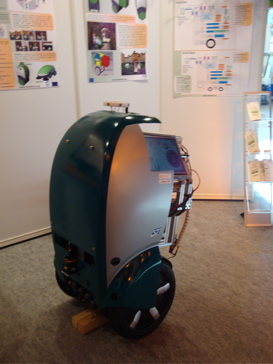
Talking of robots I came across the following whilst touring the exhibition hall at last month’s conference. The DustBot project aims to improve urban hygiene by developing a network of autonomous, but co-operating, cleaning robots. There are two types: the cleaning robot is equipped with things like a vacuum cleaner whilst the dustcart robot (see photo) is an ‘on-demand’ service that lets you drop a full bin liner into its holder and then carries it away.

Apart from investigating general aspects of robotics it turns out that there is also a pressing need for a system that can handle rubbish collection from the really old, touristy parts of European cities. In places like these there’s often no space for bins and the dustcarts just can’t fit down the narrow streets.

There are going to be five demonstrators set up in cities in Italy, Spain and Sweden, but I’m toying with the idea of requesting a sixth, in Nottingham, to be tested in an ‘industrial’ environment. I reckon it’s just what we need in the office. I can sit here, finishing off a packet or two of sandwiches, and then call up DustBot for a spot of post-prandial waste disposal. Who knows, I might even get a bit of light dusting into the bargain.

Semantic Robots

December 2, 2008

One of the sessions at last week’s European ICT 2008 conference looked at the area of robotics research. It was pointed out that we are starting to see robotic applications move beyond their traditional use in high end automobile manufacturing (remember the Picasso car advert?). There is a push to put manufacturing robots like this into smaller companies and also a lot of work going on for applications in the health and service industries. Of most interest though, I thought, were discussions about plans to integrate robotic work with that of the semantic Web to deliver knowledge-based robotics.

You can read a bit more about these semantic robots on the JISC TechWatch blog, which I will be contributing to over the coming months.

Mêlée

November 28, 2008

It is no accident that the word mêlée is French. It pretty accurately describes their understanding of the concept of queueing – a kind of cross between mingling and hand-to-hand combat, to be deployed when defending access to meat-based products at lunchtime.

However, all has not been lost from the Techlunch point of view. The French custom of serving wine at lunch in order to make the afternoon speakers more interesting has been maintained. And cakes have been served at every possible opportunity to absorb the heart-stopping levels of caffeine. The most interesting of these was a very thin, flat, rectangular shaped waffle thing coated in a lemon flavoured icing sugar. Not only were these very tasty but they were also a novel source of entertainment. I had great fun spotting those delegates who had just eaten one, given away by the shower of white dust on the front of their fancy shirts and expensive suits!

ICT 2008

November 26, 2008

Red Pizza Man Statue, Lyon

Red Pizza Man Statue, Lyon

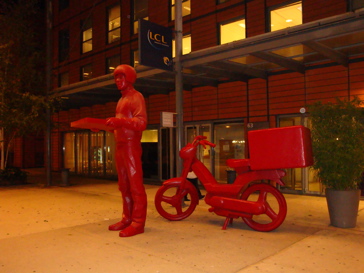
You know you’ve arrived at ICT 2008, the EU’s biggest research technology conference, when you round a corner and narrowly miss being knocked off your feet by a suited and booted segway rider. There are further techie references as you cross the courtyard of the Centre de Congrès in Lyon. The thirty-foot high, plastic pizza delivery boy for example, complete with plastic scooter, proffers an appropriately scaled pizza box. This is either something to do with the contemporary arts building next door, or a municipal French tribute to that staple of the late-night, carbohydrate-fuelled code-fest.

I’m here as part of my work for JISC TechWatch. I’ll be blogging some of the more technical stuff at TechWatch’s newly launched blog – Notes from the Future – but for the foodie stuff, stay tuned. There’s more to come on cakes, caffeine, and the comedy of European manners.